If you’ve ever thought “isn’t fuzz just more overdrive?” or “why doesn’t my boost actually get louder?” — you’re not alone.
Boost, overdrive, distortion and fuzz sit on a spectrum. The confusing bit is that they can overlap in real life: the same pedal can act like a boost in one rig and a drive in another, and a fuzz can behave like a drive if you run it into a loud, clean amp.
This guide keeps it practical: what each type does, how it feels, and how to choose based on your rig and job.
Jump to:
60-second chooser ·
Plain-English definitions ·
Your amp matters ·
Stacking rules ·
Signal chain ·
Common mistakes
Choose in 60 seconds
1) What’s the job?
- Solo lift (same tone, louder) → Boost (or volume/EQ in the loop)
- Always-on “better tone” / edge-of-breakup → Low-gain overdrive
- Tighten high gain / add focus → Mid-forward overdrive (TS-style approach)
- Make a clean amp feel like it’s breaking up → Medium-gain overdrive
- Big personality change / wool / sputter / chaos → Fuzz
2) What do you want it to feel like?
- Same sound, just more → Boost
- Touch-sensitive grit → Low-gain OD
- Smoother, focused push → Mid-forward OD
- Crunchy “amp-like” drive → Medium OD
- Woolly / sustaining wall-of-sound → Muff-style fuzz
- Spitty / gated / synthy → Modern/gated fuzz
Shop: Boost – Overdrive – Fuzz
Plain-English definitions (without the mythology)
Boost: “more signal”
A boost pedal increases level. What happens next depends on what it hits:
- If your amp is clean with headroom, boost = more volume.
- If your amp (or next pedal) is already compressing/breaking up, boost = more drive (often not much louder).
Boost is the simplest tool — and the easiest to misunderstand because the result is rig-dependent.
Overdrive: “controlled clipping + pushing the next stage”
Overdrive usually adds some of its own clipping/compression and can push what comes after it (another pedal or your amp). That’s why overdrives can feel “interactive” rather than just “more gain”.
Overdrives often fall into a few broad behaviours:
- Low-gain / transparent-ish: preserves the guitar/amp identity, adds edge and polish.
- Mid-forward: adds focus and helps you cut (and tightens low end for high gain).
- Medium/amp-ish: supplies more of its own character and can act like a “channel” on a clean platform.
If you’re in the Klon lane, you’ve already got a dedicated deep dive here:
Klon clones and alternatives.
Both Boost and Overdrive pedals are primarily designed to interact with your amp e.g. more volume from amp, or drive the amp into clipping – which is what gives the distorted “driven” sound.
Fuzz pedals tend to create the clipped waveform using electronics (diodes) with in the pedal…
Fuzz: “bigger personality change (often more self-contained)”
Fuzz generally goes further: heavier clipping and compression, more harmonic chaos, and a stronger identity. Some fuzzes are extremely touch-sensitive; others are intentionally unruly.
Two fuzz realities that matter for buyers:
- Some fuzzes interact strongly with your guitar pickups and volume knob (especially vintage-leaning circuits).
- Some fuzzes are more “self-contained” — they sound like themselves even into a clean amp (classic Muff behaviour, for example).
Our fuzz guide is here – Fuzz pedals buying guide,and if you want to go deeper, take a look at Silicon vs germanium fuzz and
Big Muff fuzz pedals.
The secret variable: what your amp is doing
The same pedal can behave differently depending on your amp’s “state”. Quick guide:
- Clean platform (headroom): overdrives provide most of the dirt character; boosts raise volume until the amp starts to clip.
- Edge-of-breakup amp: boosts and low-gain ODs feel incredible — they push the amp into a richer breakup without getting fizzy.
- Already dirty/high-gain: you’re mostly shaping and tightening; EQ voicing matters more than “gain”.
This is why some players swear a boost is “the best overdrive” — they’re boosting an amp that’s already close to breaking up.
A simple way to think about the spectrum
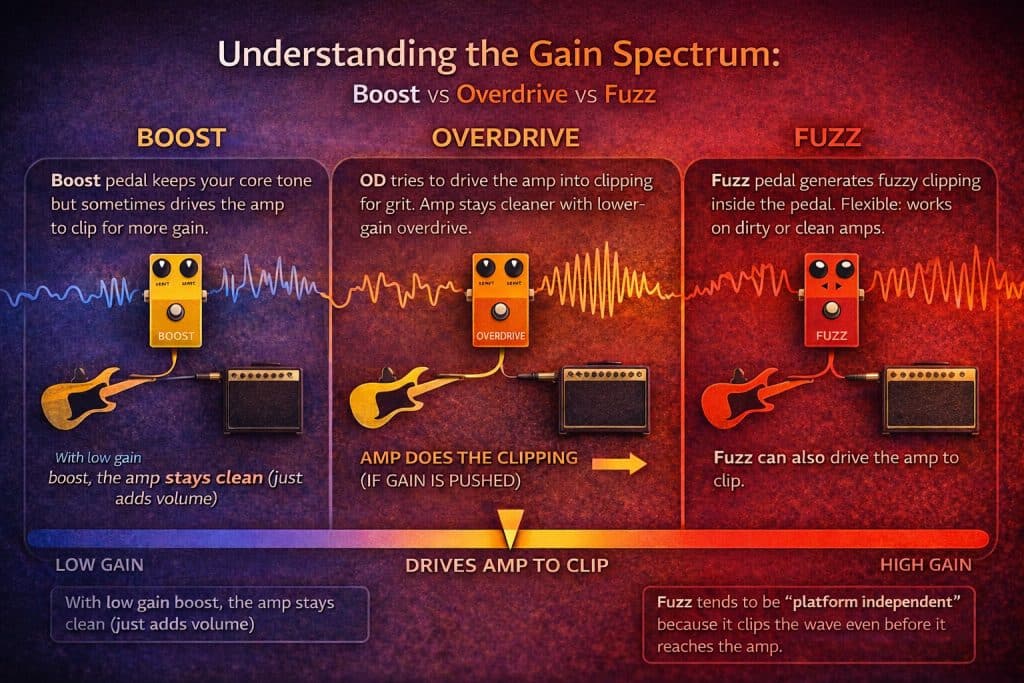
- Amount of clipping (how distorted/compressed it gets)
- Where the clipping happens (in the pedal, in the amp, or both)
- EQ voicing (what frequencies get emphasised or tightened)
Stacking rules that actually work
Stacking is where people get the most value from gain pedals — and also where things get muddy if you stack without a plan.Rule 1: Decide which pedal is your “foundation”
- Foundation (always-on): low-gain OD or Klon-style, set for feel and EQ.
- Second stage: boost for solos, or a higher-gain OD for bigger parts.
Rule 2: Boost into drive vs drive into boost
- Boost → Overdrive = more gain/sustain (pushes the drive harder)
- Overdrive → Boost = more volume (if the amp/next stage has headroom)
Rule 3: Two high-gain stages usually equals mush
If both pedals are set to high gain, you often get compression, noise and lost definition. Better approach:- One pedal low gain (tone/feel) + one pedal used as level/shape.
Rule 4: Fuzz stacking is its own thing
- Fuzz → boost can lift solos while keeping the fuzz character.
- Boost → fuzz can get wild fast (great if you want it; not always if you don’t).

Where they go in the signal chain
Starting point that works for most boards:
- Guitar → (wah) → boost/overdrive → modulation → delay → reverb → amp
Two real-world notes:
- Vintage-leaning fuzz often wants to be early (sometimes right after the guitar) because it likes to “see” your pickups.
- Boost for volume sometimes works best late in the chain or in an effects loop (if you use one), because earlier boosts can just add more gain instead of loudness.

Common mistakes (and quick fixes)
“My boost doesn’t get louder”
Your amp/next stage is already compressing. Try:- Moving the boost later, or
- Using the FX loop for volume lift (if your amp has one), or
- Using an EQ as a “solo boost” (adds level + a mid lift).
“My overdrive sounds thin / fizzy”
- Reduce gain; raise level slightly; and don’t be afraid of a little amp breakup.
- If stacking, reduce bass before the next gain stage.
“My drive disappears in the band mix”
- This is usually an EQ issue, not “not enough gain”. Add mid focus, reduce excessive low end, and keep presence controlled.
“My fuzz is uncontrollable / won’t clean up”
- Check what’s in front of it (buffers/always-on tuner), and try moving fuzz earlier.
- Try the guitar volume knob — many fuzzes are designed around it.
So what should you buy?
If you want a simple recommendation framework:
- Want a solo lift and love your base tone? Start with a clean boost.
- Want edge-of-breakup and touch dynamics? Start with a low-gain overdrive.
- Want to tighten high gain? Start with a mid-forward overdrive.
- Want a clean amp to feel like it’s breaking up? Start with a medium/amp-ish overdrive.
- Want a huge personality change? Start with fuzz.
Shop: Boost · Overdrive · Fuzz
Related guides
- Overdrive & Boost Pedals Buying Guide
- Fuzz pedals buying guide
- Klon clones and alternatives
- Silicon vs germanium fuzz
- Big Muff fuzz pedals
Want a quick recommendation? Tell us your amp + pickups + what you’re trying to achieve.