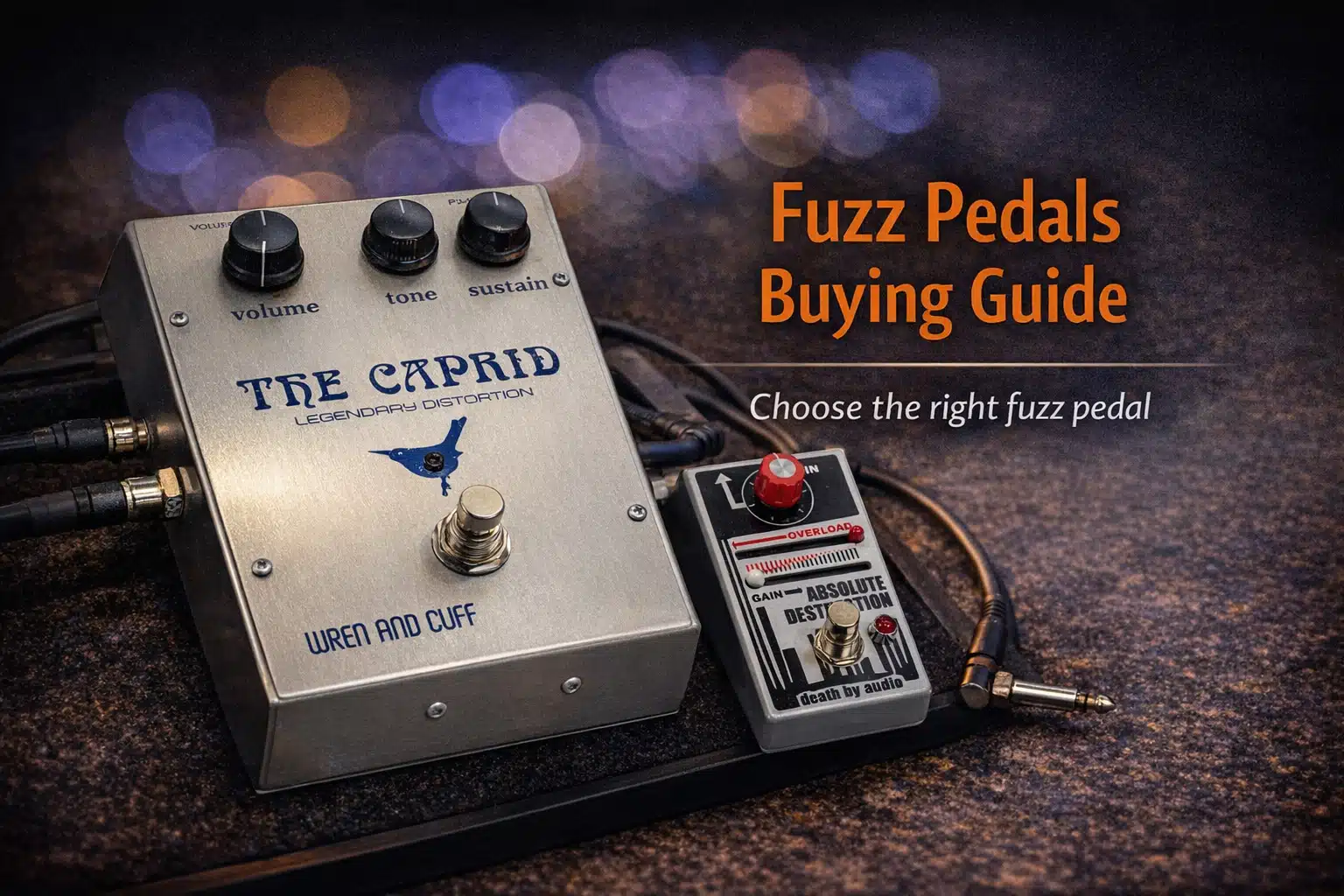
Most “fuzz pedal” content starts with a list. That’s fine for browsing, but it’s a poor way to choose a fuzz you’ll actually keep.
Fuzz is less like “an effect” and more like an instrument: it changes how your guitar reacts to your hands, your volume knob, and what comes before/after it.
This guide is process-first: pick the feel, pick the job, then match that to the fuzz family and features that matter, and then …
Choose your fuzz pedal in 60 seconds

1) What do you want it to feel like?
- Clean-up-with-your-volume, vintage, touch-sensitive → Fuzz Face / germanium-style
- Raspier, punchier, classic British bite → Tone Bender family
- Big, sustaining wall-of-sound → Big Muff family
- Upper-octave scream / Hendrix-y lead textures → Octave fuzz
- Spitty, gated, velcro, synthy → Gated / modern fuzz
2) What’s the job?
- Vintage rhythm + cleans up beautifully → Fuzz Face-style
- Classic rock bite that cuts → Tone Bender-style
- Sustaining leads + huge chords → Muff-style
- Single-note lines that jump out → Octave fuzz
- Noise/experimental / modern heavy → Gated/modern fuzz
3) How do you like to work?
- Fast & simple: Volume + Fuzz + Tone (done)
- Tweaker & deep: bias/gate, EQ, multiple modes/voices
Is fuzz just “more overdrive”?
Not really. Overdrive and distortion usually aim for a controllable, predictable gain sound. Fuzz often goes further: more clipping, more compression, and more interaction with your guitar and pickups. If you want the quick rule of thumb:- Boost/OD = keep your core tone, push the amp/pedal harder
- Distortion = more saturation with a tighter, more consistent feel
- Fuzz = a bigger personality change (sometimes gloriously unruly)
Silicon vs germanium (what it means in real life)
This topic gets its own deep dive on Guitar FX Direct, so we’ll keep it practical here:- Germanium-style tends to be softer, rounder and cleans up beautifully with your guitar volume.
- Silicon-style is typically brighter, tighter and more aggressive (and usually more consistent across temperatures).

Fuzz types (and how to know you’re in the right lane)

1) Fuzz Face-style: touch-sensitive, cleans up, vintage feel
The feel: responsive and dynamic. Roll your guitar volume down and it can go from fuzzy to almost-clean without touching the pedal.
- Great for: vintage rock, blues-rock, expressive lead work, players who ride the guitar volume
- Watch-outs: can be picky about buffers and pedal order (see signal chain section)
Examples we stock (start here):
- Fulltone fuzz (including classic-leaning fuzz options)
- Wren and Cuff (Fuzz Face-inspired lines alongside Muff variants)
2) Tone Bender-style: classic British bite, more mid presence
The feel: a bit raspier and punchier than a typical Fuzz Face, with that classic British “bite” and strong mid character.
- Great for: Beatles-ish textures, glam/classic rock, riffs that need to cut
- Watch-outs: like many vintage-leaning fuzzes, placement can change the feel a lot
Examples we stock:
- Deep Trip Kryptone (Tone Bender-derived “classic British fuzz” lane)
- Browse Deep Trip fuzz
3) Big Muff-style: sustaining wall-of-sound
The feel: thick, sustaining, and “bigger than the amp”. Muffs are a whole universe: some are scooped, some are mid-forward, some are tighter or bassier. Can be “cello-like” in their sustain.
- Great for: huge chords, sustaining leads, doom/stoner/alt, “endless sustain” sounds
- Watch-outs: some variants can feel scooped in a dense band mix unless you choose a mid-friendly version
We’ve already got a dedicated guide here:
Big Muff Fuzz Pedals
Examples we stock:
- Wren and Cuff Tall Font Russian (Sovtek-style Muff flavour)
- Black Arts Toneworks Crown of Horns (Muff-inspired, heavy-friendly voice)
- Browse Black Arts Toneworks
4) Octave fuzz: upper-octave lead textures
The feel: a fuzz plus an octave-up overtone that jumps out on single notes (especially higher up the neck). It can be smooth, snarling, or downright feral depending on the circuit.
- Great for: lead lines, classic psychedelic tones, solos that need to pop
- Watch-outs: chords can get chaotic; this is usually a “single note hero” effect
Examples we stock:
5) Modern / gated / velcro fuzz: spitty, synthy, extreme
The feel: this is the land of bias controls, gating, sputter, oscillation, and “that’s not a guitar anymore”. Some modern fuzzes can also back down into usable drive/fuzz textures—handy if you want one box to do a lot.
- Great for: modern heavy, experimental textures, glitchy riffs, noise/ambient weirdness
- Watch-outs: can be amp/pickup sensitive; the magic is often in the tweakability
Examples we stock:
Fuzz controls that actually matter
- Volume / Level: fuzz pedals can be loud—this control is part of the sound, not just “output”.
- Fuzz / Gain: amount of clipping/compression. Lower settings can be surprisingly usable.
- Tone: brightness vs thickness. On Muff-style fuzz, this can make or break the mix position.
- Bias / Gate (if included): shifts from smooth sustain to spitty, gated textures.
- Mids / EQ (if included): the “band mix” control—especially useful for Muff flavours.
Where fuzz goes in the signal chain
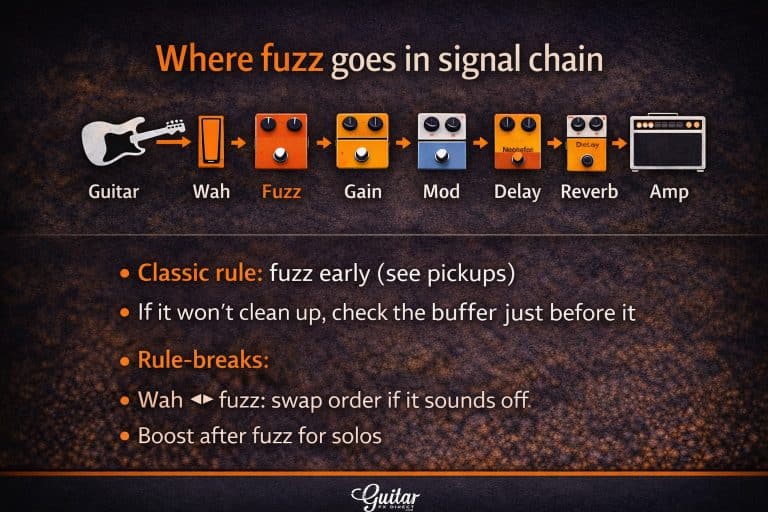
Fuzz is the one effect where order can completely change how it behaves. These starting points work for most boards:
- Classic rule: put fuzz early—often right after the guitar (or after a wah, depending on the fuzz).
- Buffers can matter: some vintage-leaning fuzzes prefer to “see” your pickups directly. If your fuzz suddenly feels stiff or won’t clean up, check what’s in front of it.
- After fuzz: drives, modulation, delay, reverb usually behave as expected.
Two useful rule-breaks:
- Wah ↔ fuzz: some rigs like wah before fuzz, some like fuzz before wah. If you get squeal or weird impedance issues, swap the order and re-test.
- Fuzz into clean boost: great for pushing solos without changing the fuzz character too much.
And yes, clean power matters if your rig is noisy: Guitar pedal power supplies (guide).
3 quick setups that work
1) One fuzz that covers the most ground
- If you want “volume-knob magic”: start in the Fuzz Face lane.
- If you want classic rock bite: start in the Tone Bender lane.
- If you want huge sustain: start in the Muff lane.
2) A classic “board-friendly” heavy rig
- Fuzz (Muff-style) → drive/boost → delay → reverb
- Tip: use a mid-friendly fuzz or a mid-boost after it if you get lost in the mix.
3) Modern gated textures without losing control
- Gated fuzz → delay → reverb
- Tip: keep your noise floor in mind; gated fuzz can exaggerate bad power/grounding.
Common fuzz mistakes (and easy fixes)
- “My fuzz sounds harsh/fizzy”
Fix: back off the Tone, reduce Gain, and try it into a slightly dirtier amp sound (or add a touch of post-fuzz drive). - “My fuzz disappeared in the band”
Fix: choose a mid-friendly fuzz (or add mids/EQ after), and reduce low-end flub. - “It won’t clean up with my guitar volume”
Fix: check what’s in front of it (buffers/always-on tuners), and try moving fuzz earlier. - “It’s noisy”
Fix: check power, cables, and grounding; some fuzzes amplify everything (including problems).
Browse fuzz pedals
Related guides & deep dives
- Silicon vs Germanium Fuzz
- Big Muff Fuzz Pedals
- Delay pedals buying guide
- Reverb pedals buying guide
- Power supplies buying guide
Want help choosing? Send us your rig + the fuzz feel you want.